
Affiliate disclosure: This article contains affiliate links. If you purchase through these links, we may earn a small commission at no extra cost to you. We only recommend tools we’d actually use on a job site.
What Is Microcement — And Why It Belongs in Your Bathroom
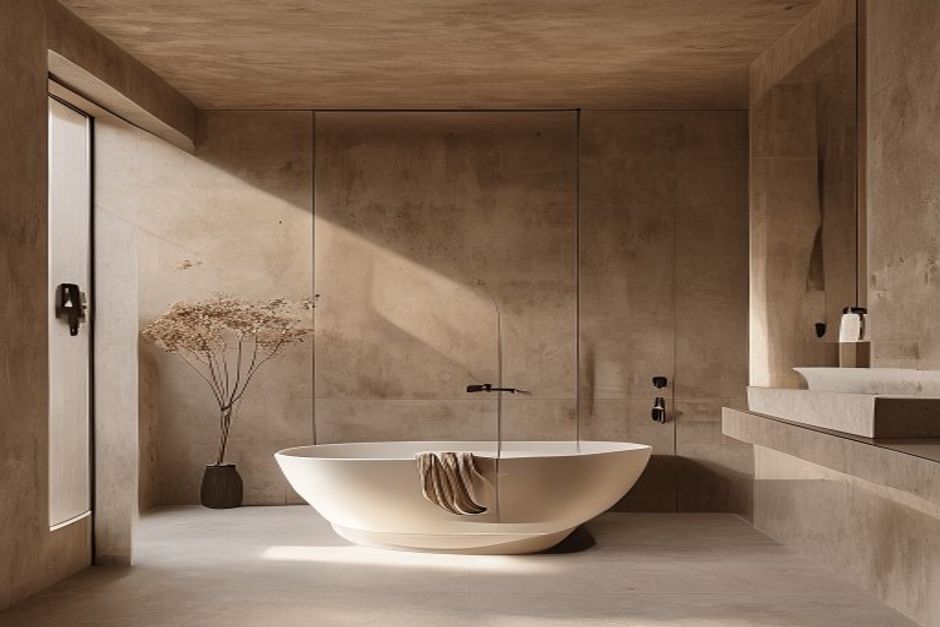
Microcement is a polymer-modified, cement-based coating applied in ultra-thin layers (1–3 mm) over nearly any stable substrate. Unlike traditional tile or stone, it creates a seamless, jointless surface with zero grout lines to scrub or reseal.
The material bonds to drywall, concrete, existing tile, plywood, and even Kerdi board. Applied correctly with a proper sealer, it becomes fully waterproof — making it a legitimate shower and wet-room finish.
As someone who has spent years working with plaster and cement-based coatings, microcement feels like a natural extension of traditional plastering. The trowel technique, the importance of substrate prep, the way each layer builds on the last — the fundamentals are identical. The difference is the final aesthetic: a polished, modern concrete look instead of a smooth painted wall.
Tools and Materials You Need
Microcement application requires specific tools. Using the wrong trowel or skipping waterproofing will show in the finished result. Here is every item you need before mixing your first batch.
Essential Tools
| Tool | Purpose | Recommended Size |
|---|---|---|
| Stainless steel pool trowel | Primary application and smoothing | 14–16 inches |
| Flexible finishing trowel | Tight corners, edges, around fixtures | 6 inches |
| Rub brick (20-grit) | Smoothing drips and high spots between coats | 6 × 3 × 1 inch |
| Paddle mixer + drill | Mixing microcement to correct consistency | – |
| Foam roller (short nap) | Primer and sealer application | 9 inches |
| 80-grit sandpaper | Final smoothing before sealing | – |
| 5-gallon mixing bucket | Batching microcement | – |
A quality stainless steel pool trowel matters more than any other tool on this list. The rounded edges prevent gouging, and the flexible blade lets you feather the material smoothly across the wall. The Marshalltown 16-inch stainless steel pool trowel is a reliable professional-grade option built in the USA.
For smoothing between coats, a Marshalltown 20-grit fluted rub brick grinds down high spots better than sandpaper alone. Regular sandpaper cannot handle cured cement — you need the silicon carbide abrasive.
Materials
- Microcement compound — SureCrete SureSpray, Festfloor Hydrofest, or Smartcret kits are common brands. Budget roughly $0.85–$1.50 per square foot for the cement alone.
- Color pigment pack — mixed into the base compound. Available in 30+ shades depending on brand.
- Bonding primer — a quartz or grit-textured primer that gives the microcement something to grip.
- Waterproofing membrane — required for any wet area (shower, tub surround). SureCrete ElastoShield or RedGard are proven options.
- Polyurethane sealer — the final protective layer. Water-based formulations are required for indoor use.
If you are working on a budget, consider a Goldblatt 2-piece pool trowel set that includes both a 16-inch and 14-inch trowel — useful since you will need a smaller trowel for areas around faucets and fixtures.
Surface Preparation — The Step That Makes or Breaks Your Finish
Every cement-based coating depends on what is underneath it. Microcement is no exception. Whether you are applying over drywall, existing tile, or bare concrete, the substrate must be clean, dry, stable, and flat.
Preparing Drywall or Plaster Walls
Fill any cracks or holes with setting-type joint compound and sand them flush. If your walls have significant damage, address those repairs first — our guide on how to repair plaster walls covers the process in detail.
Once repairs are cured and sanded, wipe the entire surface with a damp cloth to remove dust. Then apply the bonding primer with a foam roller and let it dry 3–4 hours before your first coat of microcement.
Preparing Existing Tile
Microcement can go directly over stable tile. The tiles must be firmly bonded to the wall — tap each one with your knuckle and listen for hollow sounds, which indicate loose tiles that need reattachment or removal.
Sand the glazed surface with 80-grit sandpaper to remove the shine, then fill all grout lines flush with a thin layer of microcement or setting compound. Grout lines will telegraph through the finished surface if you skip this step.
Moisture Check Before You Start
Bathrooms have inherent moisture concerns. Before applying any coating, test for moisture in your walls. Microcement applied over a damp substrate will fail — the coating can delaminate, bubble, or develop mold behind the sealed surface.
Step-by-Step Application Process
The actual application follows a layered process similar to skim coating walls, but with a few critical differences in technique and timing.
Step 1: Protect Everything
Cover the floor with ram board or heavy-duty drop cloths. Mask all edges, fixtures, and trim with painter’s tape. Microcement is cement — dried splatters bond permanently to unprotected surfaces.
Wear a respirator mask, safety glasses, and disposable clothing. The dust from sanding between coats is fine silica, and the wet material causes skin irritation with prolonged contact.
Step 2: Mix the Microcement
Combine the dry microcement compound with the color pigment and water according to the manufacturer’s ratio. Mix with a paddle mixer on a drill until you reach a smooth, pancake-batter consistency.
Critical tip: mix only what you can apply in 30–60 minutes. The material begins to thicken as it hydrates, and adding more water to thin it out changes the final color. This is the number one reason DIYers end up with patchy, uneven walls.
Step 3: Apply the First Coat (Base Coat)
Load your pool trowel and apply the material in thin, overlapping strokes. Hold the trowel at a 15–30 degree angle to the wall. Work in one direction per section.
Place the trowel on the bare wall and push material back into the wet edge of the area you have already covered. This prevents the trowel from dragging through finished work and leaving chatter marks — a technique any experienced plasterer knows instinctively from prepping walls.
The first coat does not need to look perfect. Its job is to create a uniform base for the finish coat. Let it dry for 6–8 hours minimum (24 hours is safer in humid bathroom environments).
Step 4: Sand Between Coats
Once the first coat is fully dry, use a rub brick to knock down any ridges, trowel marks, or drips. Follow with 80-grit sandpaper for a smoother profile. Vacuum or wipe away all dust before the next coat.
Step 5: Apply the Finish Coat
The second coat is where the final look emerges. You have three texture options depending on your technique:
| Finish Style | Technique | Best For |
|---|---|---|
| Smooth / polished | Tight, flat trowel strokes with firm pressure | Modern minimalist bathrooms |
| Rustic / textured | Cross-hatched X strokes, lighter pressure | Mediterranean or industrial style |
| Skip-trowel | Random skip strokes leaving base coat visible | Organic, wabi-sabi aesthetic |
Apply the finish coat at 1–3 mm thickness. Thicker is not better — excess material cracks as it cures. Let this coat dry at least 24 hours before sanding.
Step 6: Final Sanding
Sand the entire surface with 80-grit sandpaper. For shower walls that will see daily water contact, go over them a second time with 120-grit for a smoother, more sealed profile. Remove all dust.
Waterproofing and Sealing for Wet Areas
This is the step that separates a bathroom-grade microcement job from a decorative wall treatment that falls apart in three months. Every surface that will see direct water contact needs both a waterproofing membrane and a topical sealer.
Waterproofing Membrane (Before Microcement)
Apply a liquid waterproofing membrane — RedGard or SureCrete ElastoShield — to the substrate before your first coat of microcement. Roll on two coats, letting each one dry until it turns from pink to solid red (for RedGard). This membrane is your insurance policy against water reaching the drywall or framing behind the microcement.
Cover the full shower zone: floor to ceiling on all shower walls, and at least 6 inches beyond the shower door or curtain line.
Sealer (After Microcement)
After the final coat is sanded and dust-free, apply a water-based polyurethane sealer. SureCrete XS327 is purpose-built for microcement and cures to a matte finish. Apply 3–4 coats on shower walls and 2 coats on dry bathroom walls.
Wait 12 hours between sealer coats. After the final coat, allow a full 7-day cure before exposing the surface to running water. Two weeks is even better if your schedule allows it.
Warning: Never use oil-based sealers or products like Thompson’s WaterSeal indoors. They contain biocides not rated for interior use and will off-gas in a confined bathroom.
Cost Breakdown: Microcement vs. Tile vs. Other Finishes
Microcement is often chosen for its seamless look, but it is also surprisingly affordable as a DIY project compared to a full tile job.
| Finish Type | DIY Material Cost / sq ft | Pro Installed Cost / sq ft | Grout Maintenance |
|---|---|---|---|
| Microcement | $1.00–$2.50 | $10–$25 | None (seamless) |
| Ceramic tile | $2.00–$5.00 | $8–$15 | Annual resealing |
| Porcelain tile | $3.00–$8.00 | $12–$20 | Annual resealing |
| Natural stone | $5.00–$15.00 | $20–$40 | Semi-annual sealing |
| Limewash | $0.50–$1.50 | $4–$8 | N/A (not waterproof) |
A typical 60-square-foot shower surround costs $60–$150 in microcement materials when done yourself. The same area in porcelain tile runs $180–$480 in materials alone — before you buy thinset, grout, and spacers. According to detailed cost tracking by DIY bloggers who have documented full bathroom microcement projects, total material costs for a complete bathroom (approximately 700 sq ft of wall coverage) average $400–$500 including waterproofing and sealer.
7 Mistakes That Ruin a Microcement Bathroom Finish
These are the errors that turn a professional-looking project into an expensive redo. Most come down to rushing the process or skipping material science basics.
- Adding water to thicken batches. Once mixed, the cement hydrates progressively. Adding water disrupts the chemical reaction and dilutes the pigment, creating visible color variations between sections.
- Skipping the waterproofing membrane in wet areas. Microcement itself is not waterproof. Without a membrane underneath, water migrates through the coating, promotes mold, and causes delamination within months.
- Applying coats too thick. Exceeding 3 mm per coat invites cracking as the material cures and shrinks. Two thin coats at 1–1.5 mm each outperform one thick 3 mm coat every time.
- Removing painter’s tape after the microcement dries. Pull tape while the material is still damp. Dried microcement bonds to tape and pulls away in chunks, leaving ragged edges that require rework.
- Using the wrong sealer. Oil-based polyurethanes yellow over time and emit harmful VOCs indoors. Stick to water-based, low-VOC sealers rated for wet environments. If you value low-toxicity products, our guide to low-VOC and eco-friendly paints covers the same principles for coatings.
- Insufficient cure time before water exposure. Sealer needs 7–14 days to fully cross-link. Running a shower on day 3 can cloud or soften the finish permanently.
- Not testing moisture in the substrate first. Damp drywall or concrete traps moisture under the waterproofing membrane, creating a sealed-in problem that manifests as bubbling or mold months later.
Microcement vs. Other Specialty Wall Finishes
If you are considering a seamless wall finish for your bathroom, microcement is not the only option. Here is how it compares to other popular choices.
| Feature | Microcement | Venetian Plaster | Tadelakt |
|---|---|---|---|
| Waterproof (with sealer) | Yes | No (moisture-resistant only) | Yes (inherently) |
| DIY difficulty | Moderate | Moderate–High | High (requires burnishing) |
| Material cost / sq ft | $1.00–$2.50 | $0.50–$2.00 | $3.00–$6.00 |
| Suitable for showers | Yes | No | Yes |
| Finish options | Matte, satin, rustic | High gloss, marble-like | Smooth, polished stone |
| Applies over tile | Yes | Possible (not ideal) | No |
For similar specialty wall techniques, check out our guide on how to texture drywall walls — some of the trowel skills overlap directly.
Frequently Asked Questions
Can you apply microcement over existing bathroom tiles?
Yes. The tiles must be stable, clean, and lightly sanded to remove any glaze. Fill all grout lines flush before applying the bonding primer and first coat. If any tiles are loose or hollow-sounding when tapped, reattach or remove them first. Microcement bonds mechanically, so it needs a rough, dust-free surface to grip.
How long does microcement last in a shower?
Properly applied and sealed microcement lasts 15–20 years in a shower environment. The sealer is the weak link — plan to reapply a maintenance coat of polyurethane sealer every 3–5 years to keep the waterproofing intact. Between reseals, clean with pH-neutral products only. Acidic cleaners degrade the sealer over time.
Is microcement slippery when wet?
A matte or satin finish provides reasonable traction when wet, comparable to honed natural stone. For shower floors specifically, request or apply a non-slip additive (fine silica aggregate) to the sealer coat. Avoid high-gloss sealers on any horizontal surface that gets wet.
Can you DIY microcement with no plastering experience?
Yes, but start small. A powder room vanity wall or a single accent wall lets you learn the trowel technique before committing to a full shower surround. The learning curve is real — your second wall will look noticeably better than your first. Budget an extra 20–30% on materials for practice and waste.
Does microcement crack over time?
Hairline cracks can develop due to building settlement or thermal movement, but they are cosmetic rather than structural. Applying the material in thin coats (under 3 mm each) and using a flexible sealer minimizes cracking. If cracks do appear, they are straightforward to repair by sanding the area and applying a thin skim coat.
Get Our Free Home Improvement Checklists
Surface prep guides, paint finish selectors, and project planning templates — delivered to your inbox.
Final Thoughts
Microcement is one of the few bathroom finishes where DIY results can genuinely match professional work — if you respect the process. Thin coats, proper waterproofing, and patience during the cure are not shortcuts you can skip.
The material cost is a fraction of tile. The tools are accessible. And the finished result — a seamless, modern, waterproof surface with no grout to maintain — makes the 5-day project timeline worthwhile.
If you are new to cement-based wall coatings, start with our skim coating guide to practice the trowel mechanics. The hand movements are almost identical, and skim coat compound is more forgiving than microcement for a first-timer.
About the Author
This article is written by a professional plasterer-painter with over 15 years of hands-on experience in surface preparation, plaster application, and specialty wall finishes. Every technique recommendation is grounded in real-world trade knowledge.
Get Your Free Home Renovation Checklist
Join 500+ homeowners saving money on their renovations. Free checklist + weekly tips.